
Every day in Burundi, elderly mothers and fathers face life-threatening medical emergencies—strokes, heart attacks, complications from diabetes, respiratory illnesses, or untreated injuries. Yet, for many, the greatest challenge is not the illness itself, but the lack of transport to reach a hospital or health facility in time.
In a country where poverty is widespread and health infrastructure is under strain, the elderly are among the most vulnerable. They often live in fragile conditions, far from hospitals, with no personal vehicles, and little financial capacity to pay for commercial transport. For seniors in medical distress, the absence of adequate medical transport can mean the difference between life and death.
It is within this urgent context that Burundi Elderly Home Care (BEHC), founded in 2020 by Mr. Rubashamuheto Jesus-Marie and co-founded by Ms. Nimbona Alida, is raising its voice and calling for global solidarity. Officially licensed in 2025 and based in Bujumbura, Burundi, BEHC is advocating for a sustainable solution: a dedicated ambulance service to transport elderly citizens to health facilities when emergencies strike.

Inadequate Medical Transport: A Daily Struggle for the Elderly
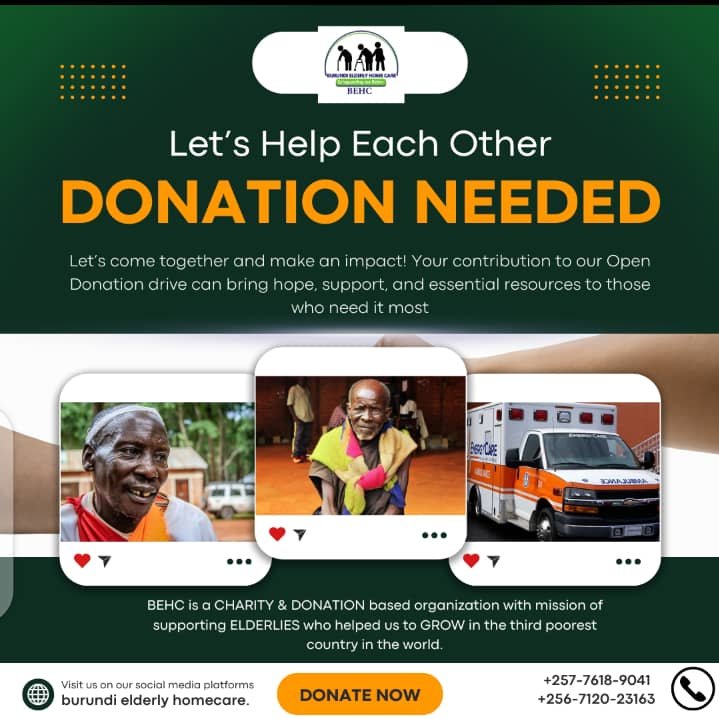
In Burundi, public ambulances are extremely limited and often concentrated in major hospitals in urban areas. For most elderly citizens—particularly those in rural villages—there is no reliable way to access emergency care.
Common realities faced by elderly Burundians include:
- Carrying patients on makeshift stretchers or bicycles for long distances, often worsening their condition.
- Relying on costly private vehicles or motorcycle taxis, which many elderly or their families cannot afford.
- Delays in treatment, with seniors arriving at hospitals too late for life-saving interventions.
- Emotional trauma, as families watch their loved ones suffer without hope of urgent medical attention.
For seniors already weakened by age and poverty, such conditions lead to preventable deaths and unnecessary suffering.
The Power of Mobility in Elderly Care
Mobility is not simply about movement—it is about access to survival, dignity, and hope. For Burundi’s elderly:
- An ambulance can be the bridge between life and death, ensuring timely access to emergency care.
- Reliable medical transport allows continuity of treatment for chronic illnesses like HIV/AIDS, hypertension, and diabetes.
- Mobility also promotes social inclusion, allowing seniors to attend community events, health workshops, or counseling sessions without being confined to their homes.
The power of mobility lies in its ability to restore dignity and give elderly people the chance to live healthier, more connected lives.
The Role of Burundi Elderly Home Care
Since its founding, BEHC has been committed to improving the lives of Burundi’s elderly through advocacy, direct support, and policy engagement. Recognizing the urgent gap in medical transport, the organization is now lobbying for the purchase of an ambulance dedicated to serving elderly citizens.
- Budget and Appeal
BEHC seeks to raise $30,000 USD to acquire a well-equipped ambulance capable of reaching elderly patients in both urban and rural areas. - Intended Impact
- Rapid response to medical emergencies among elderly citizens.
- Reduced mortality from treatable conditions.
- Support for mobility-challenged seniors requiring regular hospital visits.
- Relief for families who currently struggle with the financial and logistical burden of transporting loved ones.
- Long-term Vision
The ambulance will not only provide emergency transport but also serve as part of BEHC’s broader vision for elderly-friendly healthcare systems in Burundi.
A Call for Global Researchers and Partners
While BEHC is taking steps to address the problem, the need for global research and collaboration cannot be overstated. Elderly medical transport is rarely studied in low-income countries, leaving a critical gap in evidence-based interventions.
Global researchers and partners are urgently needed to:
- Study the impact of medical transport on elderly survival and quality of life in resource-poor settings.
- Develop cost-effective models for rural ambulance services tailored to Burundi’s terrain and economic realities.
- Innovate mobile health solutions, integrating ambulances with telemedicine and community-based care.
- Advocate for policy change, ensuring elderly transport becomes part of national healthcare strategies.

Conclusion
Every day, elderly parents in Burundi face emergencies without the means to reach care. Their lives are cut short not by the inevitability of old age, but by the absence of something as basic as a ride to the hospital.
Burundi Elderly Home Care is determined to change this reality by mobilizing resources for a dedicated ambulance at the cost of $30,000 USD. This investment will not only save lives but also restore dignity to a generation that has given so much to society.
However, this is not a journey BEHC can walk alone. Global researchers, donors, and partners must join hands to design sustainable interventions that ensure the elderly in Burundi—and across the developing world—are not left behind in times of medical crisis.
Because for the elderly, mobility is not a privilege—it is a lifeline.